Quotations: The Ultimate Guide to Using Quotes in Writing (2026)
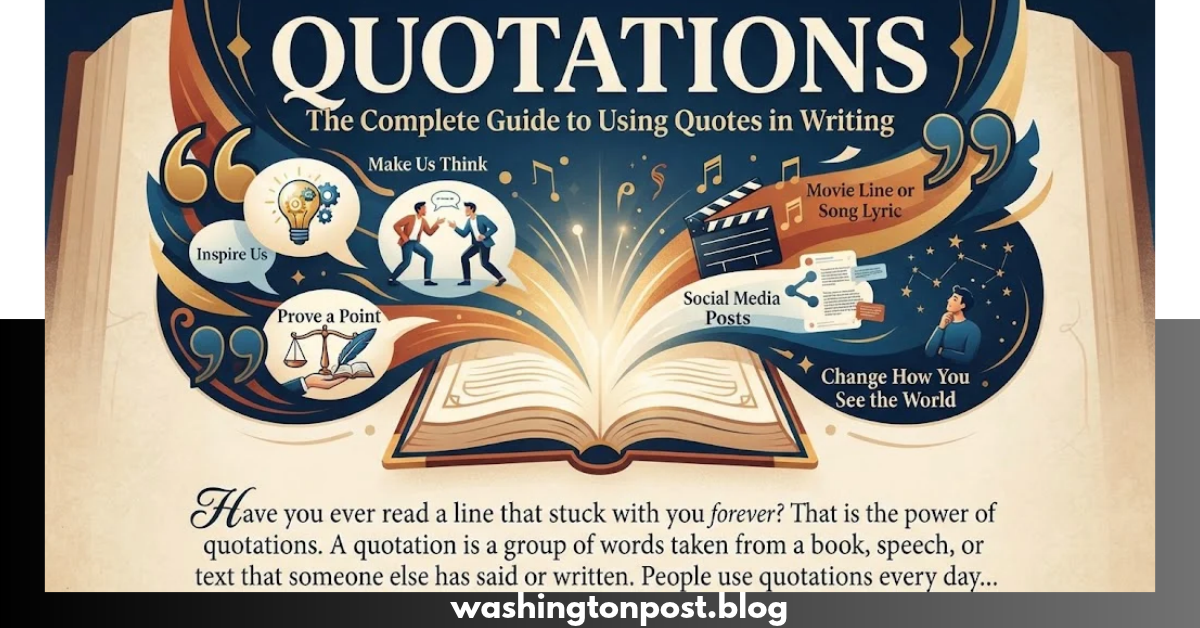
Have you ever read a line that stuck with you forever? That is the power of quotations. A quotation is a group of words taken from a book, speech, or text that someone else has said or written. People use quotations every day. They share them in speeches, articles, and even casual talks. Quotations can inspire us. They can make us think. They can also help us prove a point. When you use a quotation, you borrow the wisdom of others. This makes your own words stronger.
Think about your favorite movie line or song lyric. That is a quotation too. Quotations are everywhere. They are in books, movies, speeches, and social media posts. People love quotations because they capture big ideas in just a few words. A good quotation can change how you see the world. It can also make you feel less alone. When someone says exactly what you are feeling, it is a special moment. That is why quotations matter so much in our daily lives.
What Exactly Are Quotations?
A quotation is the exact repetition of someone else’s words. It can be a sentence, a phrase, or even a single word. In writing, we show quotations by using quotation marks. These little marks tell the reader, “These are not my words. These belong to someone else.” Quotations can come from anywhere. They can come from famous people, books, movies, or even your friends.
There are two main types of quotations. A direct quotation uses the exact words of the speaker. For example, Martin Luther King Jr. said, “I have a dream.” This is a direct quotation because it uses his exact words. An indirect quotation is different. It paraphrases or summarizes what someone said without using their exact words. For example, you could say, “Martin Luther King Jr. spoke about his dream for equality.” This is not a direct quotation because it does not use his exact words.
Quotations are also used in business. In the commercial world, a quotation can mean an estimate of costs. A contractor might give you a quotation for a home repair. In finance, quotations refer to the current price of a stock or commodity. So the word has many meanings. But in writing, it always means using someone else’s exact words.
Why Do Quotations Matter So Much?
Quotations are powerful tools. They add credibility to your writing. When you quote an expert, you show that you have done your research. This makes your arguments stronger. Readers trust you more when you use quotations from reliable sources. Quotations also add variety to your writing. They break up long paragraphs. They give your reader a fresh voice to listen to.
Quotations can also make your writing more emotional. A well-chosen quotation can touch the heart. It can make people laugh, cry, or think deeply. For example, Maya Angelou once wrote, “History, despite its wrenching pain, cannot be unlived, but if faced with courage, need not be lived again”. These words are powerful. They give comfort and hope. That is what great quotations do. They connect with us on a deep level.
Another reason quotations matter is that they preserve history. When we quote important figures, we keep their words alive. Future generations can learn from them. Quotations are like time capsules. They capture a moment in time. They let us hear the voices of people who came before us. This is why quotations are so valuable in education and research.
Direct Quotations vs. Indirect Quotations
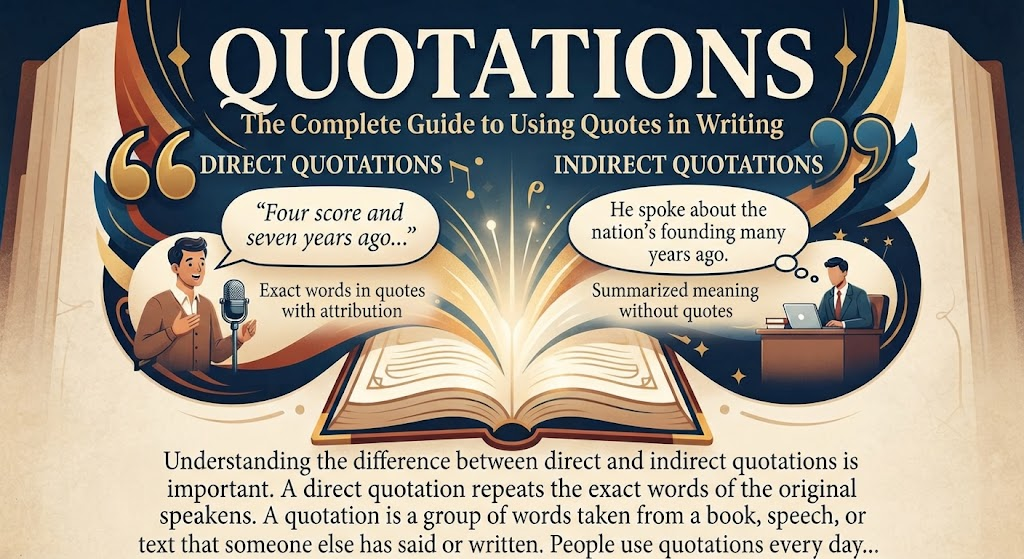
Understanding the difference between direct and indirect quotations is important. A direct quotation repeats the exact words of the original speaker. You must use quotation marks. You must also give credit to the original source. For example: Abraham Lincoln said, “Four score and seven years ago…” This is a direct quotation. It uses Lincoln’s exact words.
An indirect quotation is different. It does not use the exact words. Instead, it summarizes or paraphrases what someone said. No quotation marks are needed. For example: Abraham Lincoln spoke about the nation’s founding many years ago. This is an indirect quotation. It tells us what Lincoln said without using his exact words.
Which one should you use? It depends on your goal. Use direct quotations when the exact wording is important. Use indirect quotations when you only need to convey the general idea. Direct quotations are more powerful. They give the reader the actual words of the speaker. But indirect quotations can be useful too. They help you keep your writing flow smooth.
How to Use Quotations in Your Writing
Using quotations correctly takes practice. The first rule is to always use quotation marks. These marks tell readers that the words belong to someone else. You should also introduce every quotation you use. A quotation should never stand alone as its own sentence. Always provide context. Tell your reader who said the words and why they matter.
Here are some simple tips for using quotations effectively:
- Choose quotations that support your point. Do not use a quotation just because it sounds impressive. It should add value to your argument.
- Keep quotations short. Long quotations can bore your reader. Quote only the most important parts.
- Use signal phrases. Words like “he said” or “she wrote” help introduce quotations smoothly.
- Do not overuse quotations. Your own voice should still be the main focus. Use quotations to support your ideas, not replace them.
- Always cite your sources. Give credit to the original author. This shows respect and builds trust.
Punctuation Rules for Quotations
Punctuation can be tricky with quotations. But the rules are simple once you learn them. In American English, periods and commas always go inside the quotation marks. For example: She said, “I will be there soon.” The period goes inside the quotes. Question marks and exclamation points are different. They go inside if they are part of the quotation. They go outside if they are part of your sentence.
Here is a quick guide:
- Periods and commas: Always inside the quotation marks.
- Question marks: Inside if part of the quote, outside if not.
- Exclamation points: Same rule as question marks.
- Colons and semicolons: Always outside the quotation marks.
When you quote a quote, use single quotation marks for the inner quote. For example: She said, “He told me, ‘I love this place.'” The inner quote uses single marks. These rules might seem confusing at first. But with practice, they become second nature.
Common Mistakes to Avoid with Quotations
Many people make mistakes when using quotations. One common error is forgetting to use quotation marks. Without them, readers might think the words are your own. This is called plagiarism. It is a serious problem. Always use quotation marks for direct quotations.
Another mistake is changing the words in a quotation. A quotation must be exact. You cannot change the words to fit your sentence. If you need to change something, use square brackets. For example: “It’s [his] duty” shows that you changed the word. This tells readers that you made a small change. It keeps the quotation honest.
Some people also use too many quotations. This makes your writing feel choppy. It also drowns out your own voice. Remember, quotations should support your ideas. They should not take over your writing. Another error is using quotations without context. Readers need to know who said the words and why they matter. Always introduce your quotations properly.
Famous Quotations That Changed the World
Some quotations have shaped history. They have inspired movements and changed minds. One famous quotation is from Mahatma Gandhi: “Be the change you wish to see in the world”. These words have inspired millions of people. They remind us that change starts with ourselves.
Another powerful quotation is from Martin Luther King Jr.: “The ultimate measure of a man is not where he stands in moments of convenience and comfort, but where he stands at times of challenge and controversy”. These words call us to be brave. They remind us that true character shows in difficult times.
John F. Kennedy gave us another famous quotation: “Ask not what your country can do for you. Ask what you can do for your country”. These words inspired a generation to serve. They remind us of our duty to our communities. Quotations like these have power. They capture big ideas in memorable ways. That is why they endure through time.
How to Find the Perfect Quotation
Finding the right quotation can be challenging. But there are many resources to help you. Books of quotations are a great place to start. Websites like BrainyQuote and Goodreads have thousands of quotations. You can search by topic, author, or keyword. This makes it easy to find what you need.
When choosing a quotation, think about your audience. What will resonate with them? A quotation that inspires one person might not inspire another. Consider the tone of your writing. A serious topic needs a serious quotation. A light topic can use a humorous quotation. Match the quotation to your message.
Also, think about the source. Quotations from experts carry more weight. Quotations from famous people are also powerful. But do not ignore unknown sources. Sometimes the best quotations come from ordinary people. The key is to choose quotations that add value. They should make your writing better, not just fill space.
Quotations in Different Cultures
Quotations are not just an English thing. Every culture has its own quotations. In Chinese culture, quotations from Confucius are very important. His words have guided people for thousands of years. In Islamic culture, quotations from the Quran are central to daily life. In Western culture, quotations from the Bible and Shakespeare are common.
Different cultures also use different punctuation for quotations. In some languages, they use guillemets (« ») instead of quotation marks. In others, they use single quotation marks. These differences are fascinating. They show how quotations are a universal human practice.
Quotations also cross cultural boundaries. A quotation from one culture can inspire people in another. Gandhi’s words have inspired people all over the world. So have the words of Martin Luther King Jr. Quotations have a unique power to connect us. They remind us of our shared humanity.
Quotations in the Digital Age
Social media has changed how we use quotations. Platforms like Instagram and Twitter are full of quotations. People share them daily. They use quotations to express their feelings. They use them to inspire others. Quotations have become a form of digital communication.
But the digital age also brings challenges. Misquotations spread quickly online. People often share fake quotations. They attribute words to people who never said them. This is a problem. It spreads misinformation. Always check your sources. Make sure a quotation is real before you share it.
Another challenge is copyright. Some quotations are protected by copyright. You cannot use them without permission. But many quotations are in the public domain. These are safe to use. Always check the copyright status of a quotation. This protects you from legal trouble.
The Psychology Behind Quotations
Why do quotations affect us so deeply? Psychologists have studied this. They found that quotations activate the brain’s reward system. When we hear a meaningful quotation, our brain releases dopamine. This makes us feel good. Quotations also help us process emotions. They give words to feelings we cannot express.
Quotations also create social bonds. When we share a quotation, we connect with others. We show that we understand them. We show that we share their values. This is why quotations are so popular on social media. They help us build community.
Quotations also serve as mental shortcuts. They summarize complex ideas in simple words. This makes them easy to remember. We can recall a quotation and instantly understand its meaning. This is why quotations are so powerful in speeches. They help speakers connect with their audience.
How to Memorize Quotations
Memorizing quotations can be useful. It helps you in speeches and conversations. Start by choosing quotations that mean something to you. You will remember them more easily. Write them down. Read them aloud. Repetition helps with memory.
Break the quotation into smaller parts. Memorize one part at a time. Then put them together. This makes the task less overwhelming. Also, try to understand the meaning behind the quotation. When you understand it, you will remember it better.
Another tip is to use the quotation in your daily life. Share it with friends. Use it in your writing. The more you use it, the more you will remember it. Memorizing quotations takes time. But it is worth it. A well-timed quotation can make a big impact.
Quotations in Academic Writing
Academic writing relies heavily on quotations. They provide evidence for your arguments. They show that you have done your research. But using quotations in academic writing requires care. You must follow specific formatting rules.
Different style guides have different rules. MLA, APA, and Chicago all have their own guidelines. In MLA, you use parentheses for citations. In APA, you use the author-date format. Always check which style your instructor requires. Follow it carefully.
Also, use block quotes for long quotations. In MLA, a block quote is five or more lines. In APA, it is forty or more words. Block quotes are indented and do not use quotation marks. They stand out from the rest of your text. This makes them easy to spot.
Quotations in Speeches and Presentations
Quotations are powerful in speeches. They grab attention. They add emotion. They make your message memorable. Many great speakers use quotations effectively. Martin Luther King Jr. used quotations from the Bible. John F. Kennedy used quotations from history.
When using quotations in a speech, choose ones that are easy to say. Avoid long, complicated quotations. They can trip you up. Also, practice saying the quotation aloud. Make sure it sounds natural. The best quotations flow smoothly in your speech.
Also, give credit to the original speaker. This shows respect. It also adds credibility. Your audience will trust you more. A well-placed quotation can elevate your speech. It can turn a good speech into a great one.
The Future of Quotations
What does the future hold for quotations? Technology will continue to change how we use them. AI tools can now generate quotations. They can analyze text and find the best quotes. This makes it easier to find the perfect quotation.
But AI also raises questions. Can a machine create a meaningful quotation? Many people say no. They believe that true quotations come from human experience. Only humans can capture deep emotions in words.
Quotations will always be important. They connect us to the past. They help us understand the present. They inspire us for the future. As long as people speak and write, quotations will exist. They are a fundamental part of human communication.
Frequently Asked Questions
1. What is the difference between a quotation and a quote?
Quotation is a noun that means words taken from a text or speech. Quote is a verb that means to repeat someone else’s words. However, in everyday use, quote is often used as a shorter form of quotation. In formal writing, it is better to use quotation as the noun.
2. When should I use direct quotations?
Use direct quotations when the exact wording is important. This is common in academic writing, journalism, and speeches. Direct quotations add credibility and show that you are accurately representing someone’s words.
3. How do I properly cite a quotation?
Citing a quotation depends on the style guide you are using. In MLA, you put the author’s last name and page number in parentheses. In APA, you use the author’s last name and the year of publication. Always check your style guide for specific rules.
4. Can I change words in a quotation?
No, you should not change words in a direct quotation. It must be exact. If you need to change something, use square brackets to show the change. For example, change “I” to “[he]” to fit your sentence.
5. What are some common misquotations?
One common misquotation is “Be the change you wish to see in the world.” Many people attribute this to Gandhi. But scholars debate whether he actually said these exact words. Always verify your quotations before using them.
6. How many quotations should I use in my writing?
There is no set number. Use quotations to support your ideas. But do not overuse them. Your own voice should be the main focus. A good rule is to use one or two quotations per paragraph at most
Conclusion
Quotations are more than just words. They are pieces of wisdom passed down through time. They connect us to the past. They inspire us in the present. They guide us toward the future. Whether you are writing an essay, giving a speech, or sharing a post on social media, quotations can make your message stronger.
The key is to use quotations wisely. Choose ones that matter. Use them to support your ideas. Always give credit to the original source. Follow the punctuation rules. Avoid common mistakes. When you do all this, your writing will be more powerful. Your readers will trust you more. Your message will be clearer.
So go ahead and find your favorite quotations. Share them with the world. Let them inspire you and others. Quotations have the power to change lives. They have changed mine. They can change yours too. Start using quotations today and see the difference they make.