Antivirus FreeDoor2.4.6.8: Is It Safe to Use?
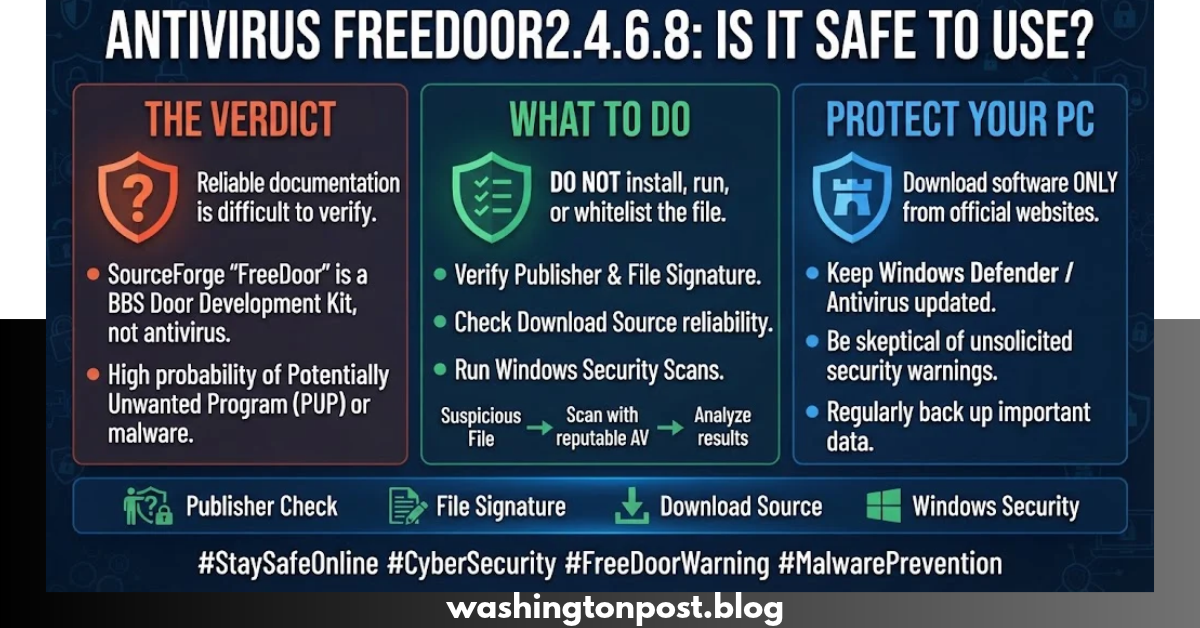
If you searched for antivirus freedoor2.4.6.8, you may have seen claims that it is an antivirus program, malware, or a security warning. The bigger issue is that reliable documentation for a legitimate antivirus product with this exact name is difficult to verify. The identifiable FreeDoor project on SourceForge is inactive and describes itself as a 32-bit BBS Door Development Kit, not an antivirus application.
That means you should not install, whitelist, or run a file simply because a website calls it security software. Instead, verify the publisher, file signature, download source, and Windows security detection before taking action.
What Is Antivirus FreeDoor2.4.6.8?
The phrase antivirus freedoor2.4.6.8 does not currently have a clear, authoritative product identity from a recognized antivirus vendor.
Search results show websites describing the name in different ways, including claims that it is antivirus software or a network utility. Those descriptions are not enough to establish that a genuine security product exists under this exact name.
There is also an older FreeDoor project on SourceForge, but its official project description identifies it as a 32-bit BBS Door Development Kit for Windows and OS/2. Its files are dated around the early 2000s, and the project is marked inactive.
Quick fact check
| Question | What can be verified |
| Is FreeDoor2.4.6.8 a confirmed antivirus brand? | No authoritative antivirus publisher was verified |
| Is the SourceForge FreeDoor project an antivirus? | No |
| What is the SourceForge project? | A BBS Door Development Kit |
| Is that project active? | No, it is marked inactive |
| Should you trust a random download? | No |
| Should you disable Windows security to install it? | No |
| What should you check first? | Publisher, signature, source, reputation, and detection |
Why Is the Name Confusing?
The main problem with antivirus freedoor2.4.6.8 is the lack of a consistent primary source describing exactly what the software is.
A version number such as “2.4.6.8” can make a program appear established, but a version number alone does not prove authenticity. Anyone can rename an executable or create a webpage using a convincing software name.
Microsoft explains that Windows evaluates downloaded programs using reputation signals, including information about the file, publisher, and digital signature. An unknown or unsigned program can therefore receive a warning even when the warning does not prove that the file is malware.
Is FreeDoor2.4.6.8 a Virus?
You should not automatically label every file carrying the name antivirus freedoor2.4.6.8 as a virus.
A suspicious name and an actual malware infection are two different things. To determine what you have, look at the exact file, its location, publisher information, security detection, and behavior.
Windows Security can identify malware as well as potentially unwanted applications. Microsoft notes that potentially unwanted apps may show unwanted advertising, install additional software, or perform other activities users did not expect.
Watch for these warning signs
- The program has no identifiable publisher.
- The download comes from an unknown website.
- The installer asks you to disable antivirus protection.
- Windows SmartScreen displays a security warning.
- The file has no valid digital signature.
- The program installs additional software without clear consent.
- Your browser suddenly shows unusual security alerts.
- The software creates unexpected startup entries.
- The download page uses aggressive pop-ups or fake scan results.
One warning does not automatically prove that a file is malicious. However, several warning signs together justify stopping the installation and checking the file before running it.
Should You Disable Antivirus to Install FreeDoor2.4.6.8?
No. Do not disable your antivirus simply to install an unverified program.
This is one of the most important safety rules when researching antivirus freedoor2.4.6.8. If Microsoft Defender, SmartScreen, or another security product blocks a file, first find out why.
Microsoft recommends downloading software from trusted sources and keeping antivirus protection updated. Windows also provides reputation-based protection to help identify unsafe applications and downloads.
What to do instead
- Keep the security warning enabled.
- Record the exact detection name.
- Check the publisher of the file.
- Inspect the file’s digital signature.
- Confirm where the file came from.
- Check whether the publisher has an official website.
- Scan the file with your security software.
- Do not run it if you cannot establish its authenticity.
This approach is safer than turning off protection and hoping the installer is legitimate.
What Does a Microsoft Defender Warning Mean?
A Windows security warning deserves attention, but you should understand what it actually says.
Microsoft Defender SmartScreen checks websites and downloaded files against reputation information and known unsafe content. It can also warn about files that lack established reputation. Microsoft specifically notes that an “unknown” or “not commonly downloaded” warning does not by itself prove that a program is malicious.
That distinction matters when investigating antivirus freedoor2.4.6.8.
Common Windows warnings
| Warning type | What it can mean |
| Unknown publisher | Windows cannot establish a trusted publisher identity |
| Unrecognized app | The file has limited reputation information |
| Malware detected | Security software has identified malicious behavior or a known threat |
| Potentially unwanted app | The program may create unwanted or risky behavior |
| Blocked download | The browser or security service considers the download unsafe |
Do not ignore the exact wording of the warning. It gives you more useful information than a generic webpage claiming that a program is “safe.”
How Can You Check a FreeDoor2.4.6.8 File?
If you already downloaded a file associated with antivirus freedoor2.4.6.8, inspect it before opening it.
1. Check the file location
Right-click the file and select Properties. Look at its location, size, creation information, and available publisher details.
2. Check the digital signature
Open the Digital Signatures tab if one exists.
A valid signature can help establish who signed the file. Microsoft explains that publisher identity and file reputation are important parts of SmartScreen’s reputation system.
3. Check Windows Security
Open:
Windows Security → Virus & threat protection → Protection history
Look for the exact detection associated with the file.
Microsoft provides Protection History to show actions taken by Defender, including blocked applications and potentially unwanted software.
4. Do not rely on the filename
A filename such as:
FreeDoor2.4.6.8.exe
does not prove that the file came from the original developer.
Attackers can rename executable files to resemble legitimate programs.
How Do You Remove Suspicious FreeDoor Software?
If you installed an unfamiliar program connected with antivirus freedoor2.4.6.8, start with normal Windows removal tools.
Remove an installed application
On Windows 11:
- Open Settings.
- Select Apps.
- Open Installed apps.
- Search for the unfamiliar program.
- Select the three-dot menu.
- Choose Uninstall.
- Restart the computer if required.
Microsoft recommends uninstalling unwanted software through Windows app settings and then running a full Microsoft Defender scan when unwanted software is suspected.
If the program will not uninstall
Do not immediately download a random “PC cleaner” from another website.
Instead:
- Update Windows Security.
- Run a full scan.
- Review Protection History.
- Run Microsoft Defender Offline if necessary.
- Check browser extensions.
- Review recently installed applications.
- Check startup applications for unfamiliar entries.
Microsoft specifically recommends Defender Offline when unwanted software remains after normal removal steps.
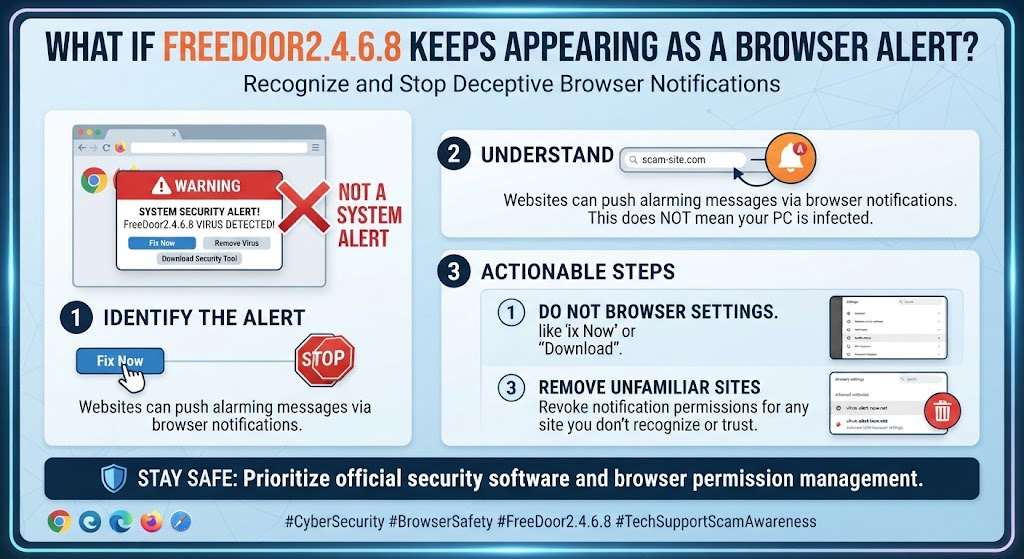
What If FreeDoor2.4.6.8 Keeps Appearing as a Browser Alert?
A security-looking message does not necessarily mean an antivirus program has been installed.
Websites can use browser notifications to display alarming messages. These notifications may look like system security alerts even though they originate from a website.
If the message appears inside your browser, check the browser’s notification permissions and remove unfamiliar websites from the allowed list.
Do not click a “Fix Now,” “Remove Virus,” or “Download Security Tool” button simply because the message looks urgent.
FreeDoor vs. Freegate: Are They the Same?
You should not assume that FreeDoor2.4.6.8 and Freegate are the same software.
The documented FreeDoor project found on SourceForge is an inactive BBS development kit. Its description does not identify it as an antivirus product.
This is an important distinction because several online pages use similar names while describing completely different software. Always identify the actual publisher and product before downloading an executable.
How to Stay Safe When Downloading Unknown Software
The safest approach to antivirus freedoor2.4.6.8 is to verify the software before installation.
Use this checklist
- Publisher: Can you identify the company or developer?
- Official source: Does the publisher provide the download?
- Signature: Is the executable digitally signed?
- Version: Does the publisher document this exact version?
- Security result: What does Windows Security report?
- Website reputation: Is the download site established and trustworthy?
- Permissions: Does the application request unnecessary access?
- Installer behavior: Does it attempt to install unrelated programs?
- Updates: Is there a legitimate update mechanism?
- Documentation: Can you find genuine technical documentation?
Microsoft recommends downloading applications from trusted sources, keeping Windows and security software updated, and using reputation-based protection.
FreeDoor2.4.6.8 Safety Checklist
| Check | Safe approach |
| Download source | Prefer the verified publisher |
| Antivirus | Keep protection enabled |
| SmartScreen | Investigate warnings before proceeding |
| Digital signature | Check the publisher identity |
| File reputation | Treat unknown files cautiously |
| Installation | Read every installer screen |
| Extra software | Reject unnecessary bundled programs |
| Browser alerts | Verify whether they are website notifications |
| Malware warning | Keep the file blocked until investigated |
| Removal | Use Windows Settings and Defender |
What Should You Do If You Already Ran the File?
If you already executed a file associated with antivirus freedoor2.4.6.8, do not panic.
First, disconnect from the internet if you notice suspicious activity such as unexpected downloads, account prompts, or unusual network behavior. Then open Windows Security and run a full scan.
If the scan identifies a threat, follow the recommended remediation steps. If the computer continues behaving unusually, run Microsoft Defender Offline for a deeper check. Microsoft provides this option specifically for cases where unwanted software may persist.
Also consider changing important passwords from a separate, trusted device if you have reason to believe the suspicious program may have accessed sensitive information.
Frequently Asked Questions
Is antivirus FreeDoor2.4.6.8 a legitimate antivirus?
Answer: There is not enough authoritative evidence to identify antivirus freedoor2.4.6.8 as a legitimate antivirus product from a recognized security vendor. The identifiable FreeDoor project on SourceForge is an inactive BBS development kit, not antivirus software.
Should I download FreeDoor2.4.6.8?
Answer: Do not download an executable merely because a third-party webpage recommends it. First establish the original publisher, official download location, file signature, and security reputation.
Should I turn off Microsoft Defender to install it?
Answer: No. Keep Microsoft Defender and SmartScreen enabled while you investigate an unfamiliar program. Microsoft recommends maintaining updated antivirus protection and using reputation-based security features.
Is a SmartScreen warning proof that FreeDoor2.4.6.8 is malware?
Answer: No. Microsoft says reputation warnings can also appear for files that are new, uncommon, or lack established reputation. However, the warning means you should verify the file before running it.
How do I remove FreeDoor2.4.6.8?
Answer: If it appears as an installed application, remove it through Settings → Apps → Installed apps, then run a full Microsoft Defender scan. If unwanted software remains, Microsoft recommends considering Defender Offline.
What is the safest way to check an unknown executable?
Answer: Check its original source, publisher, digital signature, exact security detection, and file reputation before opening it. Never rely on the filename or a third-party article alone.
Conclusion
The most important fact about antivirus freedoor2.4.6.8 is that its identity is not clearly established by an authoritative antivirus vendor. The documented FreeDoor project available through SourceForge is inactive and describes different software, so users should avoid treating similarly named downloads as automatically genuine.
If you have the actual FreeDoor2.4.6.8 file, check its publisher, digital signature, source, and Windows Security detection before running it. Keeping Microsoft Defender and SmartScreen enabled gives you an important layer of protection while you determine what the file really is.