What Is Geometry Learning V3? Complete Student Guide
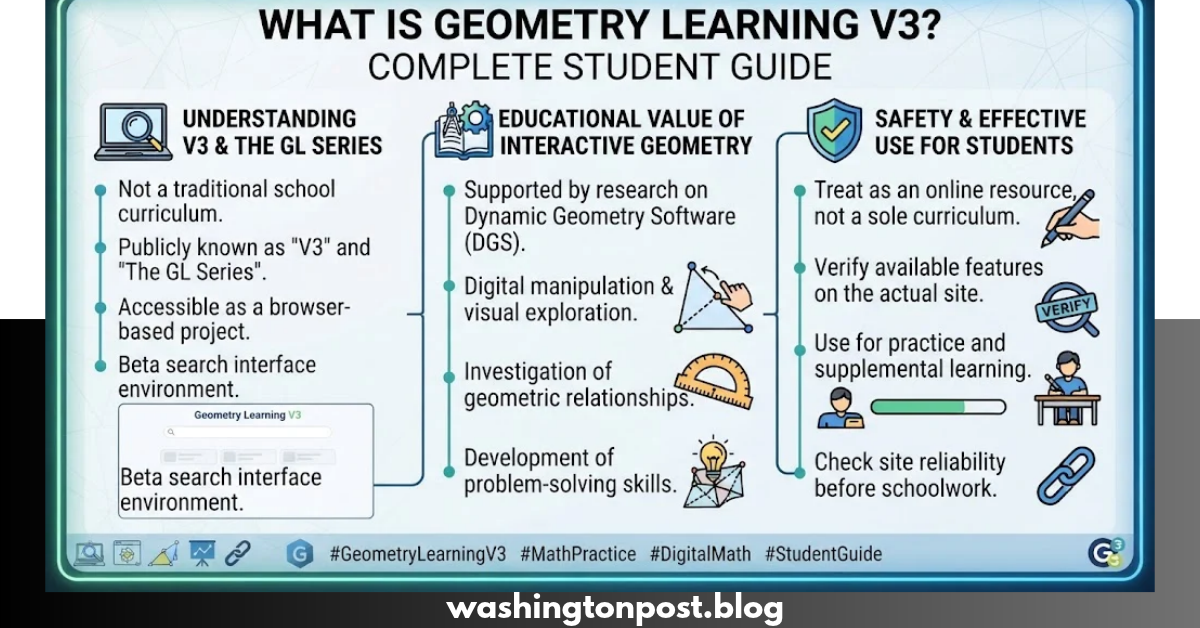
Geometry Learning V3 is a term associated with a browser-based project known publicly as V3 and The GL Series. The currently accessible project shows a beta search interface and a web-based environment rather than a clearly documented school curriculum.
That distinction matters. Several websites describe the project as an interactive geometry-learning platform, but the public interface does not provide enough evidence to confirm every feature claimed by those articles. For students, the safest approach is to treat it as an online resource and check what the actual site provides before using it for formal schoolwork.
At the same time, the basic idea behind interactive geometry learning has strong educational support. Research on dynamic geometry software shows that digital manipulation, measurement, and visual exploration can help students investigate geometric relationships and develop problem-solving skills.
Why Is Geometry Learning V3 Getting Attention?
The phrase geometry learning v3 attracts attention because it combines a familiar school subject with an interactive online format.
Traditional geometry can become difficult when students only see static diagrams. Digital geometry environments can allow learners to move points, examine shapes, test relationships, and see what changes when measurements are adjusted.
Research on dynamic geometry environments supports this general learning approach. Studies have found that tools such as GeoGebra can support visualization, active participation, mathematical reasoning, and geometry problem solving.
However, the educational value of a specific website depends on the activities it actually provides.
Is Geometry Learning V3 a Real Website?
Yes. A publicly accessible website associated with the name identifies itself as V3 and The GL Series. Its visible page also includes a beta search version.
Another publicly indexed version uses the Geometry Learn V3 name and identifies itself with the GL Series.
This confirms that the name is connected to a real browser-based project. It does not, by itself, prove that the project is an accredited educational service or an official school mathematics curriculum.
Quick facts
| Question | Answer |
| Is Geometry Learning V3 associated with a website? | Yes |
| Is it browser-based? | Yes |
| Does the public project use V3 branding? | Yes |
| Is it clearly an accredited curriculum? | Not established by the available public evidence |
| Is it associated with the GL Series? | Yes |
| Should students verify the actual content? | Yes |
What Does “V3” Mean?
The V3 label appears to indicate a version of the project.
The public page displays “V3” alongside “The GL Series” and a beta search version. However, the available public documentation does not provide enough reliable information to explain the complete development history between earlier versions and V3.
Therefore, it is better to describe V3 as the project’s visible version designation rather than claim that it represents a specific third-generation educational curriculum.
What Is the GL Series?
The GL Series is the branding visible on the publicly accessible V3 project. The available page presents V3 as part of that series.
Third-party descriptions connect the GL Series with browser-based games, apps, and additional resources. However, descriptions differ considerably between websites, so readers should rely on the actual project interface when checking available features.
This is especially important for students looking for structured lessons. A website can contain educational or mathematical material without being a complete mathematics course.
Does Geometry Learning V3 Actually Teach Geometry?
This is one of the most important questions.
The answer requires some caution. Online articles frequently describe Geometry Learning V3 as a geometry-learning platform covering topics such as shapes, angles, measurements, transformations, and spatial reasoning. But the publicly visible project does not provide enough documentation to verify that it offers a complete, standards-based geometry curriculum.
So there are two separate ideas:
- Geometry topics associated with the name online
- A formally structured geometry curriculum provided by the live project
The first is widely described online. The second has not been clearly established by the available public evidence.
For homework, exams, or formal study, students should use a verified textbook, teacher resource, school curriculum, or established mathematics platform alongside any independent website.
What Geometry Topics Should a Good Learning Resource Cover?
If you want to use geometry learning v3 for study, compare its available material against the basic topics you need.
1. Points, Lines, and Planes
Students should understand points, line segments, rays, parallel lines, perpendicular lines, and planes.
These ideas form the language used in more advanced geometry.
2. Angles
A useful geometry resource should explain:
- Acute angles
- Right angles
- Obtuse angles
- Straight angles
- Complementary angles
- Supplementary angles
- Vertical angles
- Angle relationships
Visual diagrams can make these relationships much easier to understand.
3. Triangles
Triangle lessons should normally include:
- Equilateral triangles
- Isosceles triangles
- Scalene triangles
- Right triangles
- Triangle angle sums
- Congruence
- Similarity
- Pythagorean theorem
- Area and perimeter
Triangles are central to many geometry problems.
4. Quadrilaterals and Polygons
Students should also learn about:
- Squares
- Rectangles
- Rhombuses
- Parallelograms
- Trapezoids
- Regular polygons
- Interior angles
- Exterior angles
A visual environment can help students compare these shapes instead of memorizing definitions separately.
5. Circles
Important circle concepts include:
- Radius
- Diameter
- Circumference
- Area
- Chord
- Arc
- Sector
- Central angle
- Inscribed angle
Dynamic geometry tools can be particularly useful when students need to observe how changing a radius affects other measurements.
How Interactive Geometry Learning Helps
The strongest case for digital geometry does not come from marketing claims about one particular website. It comes from research into dynamic geometry environments.
A study involving Grade 11 learners compared GeoGebra-supported circle geometry instruction with a traditional approach. The researchers reported statistically significant differences between the groups and concluded that the technology-supported group performed better in that study and reported positive learning experiences.
Another study examined dynamic geometry activities involving translations. It found that dragging and measurement features gave learners opportunities to explore properties, form conjectures, and develop understanding.
These findings support the broader learning method, but they should not be interpreted as proof that Geometry Learning V3 itself produces the same results.
What Are the Main Benefits of Geometry Learning V3?
When an online geometry resource provides useful interactive activities, students may benefit from several learning features.
Visual Understanding
Geometry is highly visual. Seeing a shape change can sometimes explain a relationship more clearly than reading a definition.
Active Practice
Interactive activities can encourage students to test ideas rather than simply read information.
Immediate Exploration
Students can investigate what happens when they change a length, angle, position, or shape.
Better Spatial Thinking
Dynamic geometry environments can help learners think about position, movement, size, and relationships between objects.
More Engaging Practice
Interactive tasks can make repeated practice feel more active than working only from a static worksheet.
Research on dynamic geometry systems has found potential benefits for student participation, visualization, reasoning, and problem solving.
What Are the Limitations of Geometry Learning V3?
A good educational decision also requires understanding the limitations.
It May Not Be a Complete Curriculum
The public information available for the project does not establish a complete sequence of lessons, assessments, curriculum standards, or accreditation.
Online Descriptions Can Differ
Third-party articles sometimes make broader claims than the project’s own visible interface supports. This is why checking the actual resource is important.
Interactive Tools Do Not Replace Understanding
A student can manipulate a shape and still fail to understand the mathematical rule behind it.
Teacher Support Can Still Matter
Research into dynamic geometry learning shows that software works within a wider teaching environment. Worksheets, discussion, instruction, and problem solving can all contribute to learning outcomes.
How to Use Geometry Learning V3 for Better Study
If you decide to explore geometry learning v3, use it as part of a simple study routine.
Step 1: Learn the Concept
Start with the definition or rule.
For example, learn what a perpendicular line means before attempting problems involving perpendicular lines.
Step 2: Explore Visually
Use an interactive diagram or activity to see the concept in action.
Step 3: Solve Without Help
Close the interactive activity and solve a few questions yourself.
This checks whether you actually understand the concept.
Step 4: Explain Your Answer
Try to explain why your answer is correct.
For example:
“These angles are supplementary because their total is 180 degrees.”
Explaining the reason strengthens mathematical understanding.
Step 5: Review Mistakes
Do not only check the final answer. Find the exact step where your reasoning went wrong.
Step 6: Practice on Paper
Digital learning should support independent mathematics skills. Complete some traditional questions without an interactive tool.
Geometry Learning V3 vs. Traditional Geometry Study
| Feature | Geometry Learning V3 / Online Resource | Traditional Study |
| Visual interaction | May be available | Usually diagrams |
| Physical textbook | No | Yes |
| Interactive exploration | Possible | Limited |
| Teacher guidance | Depends on setting | Usually available in class |
| Independent practice | Possible | Strong |
| Formal curriculum | Not clearly established | Depends on textbook/school |
| Instant digital interaction | Possible | Usually unavailable |
| Written problem solving | Still needed | Core activity |
| Best use | Exploration and practice | Structured learning |
The two approaches do not need to compete. A student can use interactive technology for exploration and then use worksheets, textbooks, or teacher-led lessons to build formal skills.
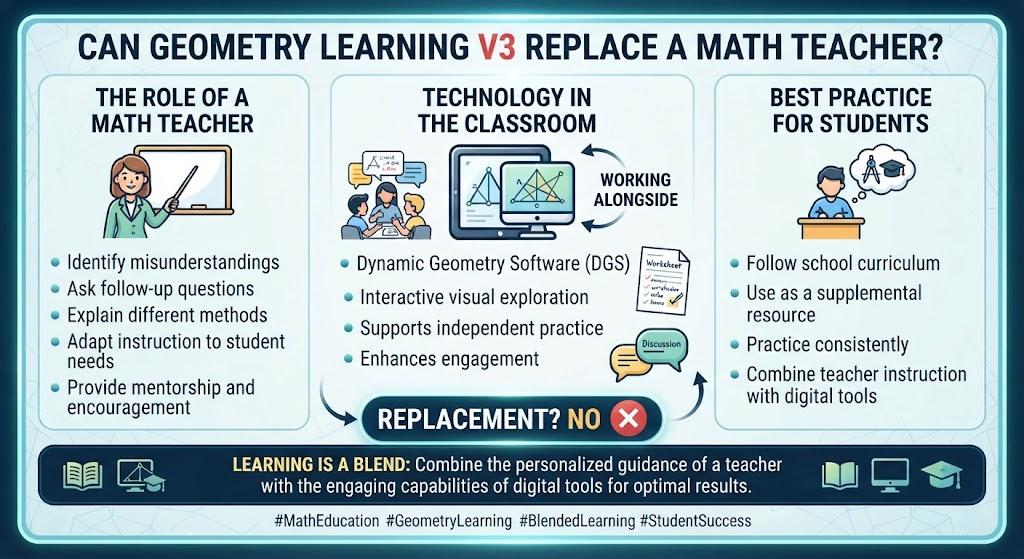
Can Geometry Learning V3 Replace a Math Teacher?
No resource should automatically be treated as a complete replacement for mathematics instruction.
A teacher can identify misunderstandings, ask follow-up questions, explain different methods, and adapt instruction to a student’s needs.
Research on dynamic geometry also shows that technology works alongside other learning factors such as worksheets, group work, discussion, and instruction.
For independent practice, an online resource can be useful. For formal education, it is better to follow the curriculum provided by the student’s school or teacher.
Is Geometry Learning V3 Safe to Use?
Students should apply normal online safety rules when visiting an independent website.
Before using any browser-based resource:
- Check the website address carefully.
- Avoid entering unnecessary personal information.
- Do not download unknown files.
- Do not install unfamiliar browser extensions.
- Avoid sharing passwords.
- Ask a parent, teacher, or guardian if a school device blocks or flags the website.
- Use school-approved resources for school assignments when required.
The public project is not presented in the available evidence as an accredited school platform, so students should avoid assuming that its content has been formally reviewed by their school or education authority.
How Does Geometry Learning V3 Compare With GeoGebra?
GeoGebra is an established dynamic mathematics platform with dedicated geometry activities and construction resources.
For example, GeoGebra provides structured activities involving triangles, circles, polygons, transformations, quadrilaterals, and geometric constructions.
That makes GeoGebra useful as a reference point when evaluating any online geometry tool.
| Area | Geometry Learning V3 | GeoGebra |
| Public V3 project | Yes | Not applicable |
| Dynamic geometry | Public descriptions vary | Established feature |
| Geometry constructions | Verify on the specific V3 resource | Available |
| Structured geometry activities | Not clearly documented | Available |
| Educational research | Evidence is mainly about the broader approach | Extensive research on dynamic geometry use |
| Best approach | Verify features before relying on it | Use established activities and tools where appropriate |
This comparison is about documented features and evidence, not a ranking.
Who Can Use Geometry Learning V3?
The answer depends on the actual material available through the project.
Potential users searching for the term may include:
- Middle school students
- High school students
- Beginners learning geometry
- Parents looking for practice resources
- Teachers exploring digital activities
- Learners interested in browser-based mathematics resources
However, students should match the resource to their grade level and learning objectives rather than choosing it only because the name contains “geometry.”
A Simple Geometry Study Plan for Beginners
Here is a practical weekly structure.
| Day | Topic | Practice |
| Monday | Points, lines and angles | 20–30 minutes |
| Tuesday | Triangle properties | 30 minutes |
| Wednesday | Quadrilaterals | 30 minutes |
| Thursday | Circles | 30 minutes |
| Friday | Area and perimeter | 30 minutes |
| Saturday | Mixed problems | 30–45 minutes |
| Sunday | Review mistakes | 20 minutes |
For each session, use this pattern:
Learn → Visualize → Practice → Explain → Review
This approach keeps interactive learning connected to actual mathematical reasoning.
Frequently Asked Questions
What is Geometry Learning V3?
Geometry Learning V3 is a name associated with a browser-based project identified as V3 and The GL Series. Its public interface does not establish it as an accredited or complete geometry curriculum.
Is Geometry Learning V3 free?
The publicly accessible project can be reached through a browser, but users should check the current website for its latest access conditions and features.
Is Geometry Learning V3 actually a geometry course?
Does Geometry Learning V3 help students learn geometry?
Can I use Geometry Learning V3 for school homework?
You can use it as a supplementary resource if your school allows it. For graded work, follow your teacher’s instructions and use the required textbook, curriculum, or approved learning platform.
Conclusion
Geometry Learning V3 is best approached with a clear distinction between the name found online and what the publicly accessible project actually documents. The V3 project is associated with the GL Series, but current public evidence does not justify treating it as an accredited or complete geometry curriculum.
The broader idea behind interactive geometry learning has stronger support. Studies of dynamic geometry tools show that visual manipulation, measurement, exploration, and guided activities can help students investigate mathematical relationships and develop geometry skills.
If you use Geometry Learning V3, focus on understanding rather than simply clicking through activities. Combine visual exploration with written problems, explanations, revision, and reliable curriculum materials. That approach gives students a much stronger foundation in geometry.