How to Fix Bug Ralbel28.2.5: A Safe Troubleshooting Guide
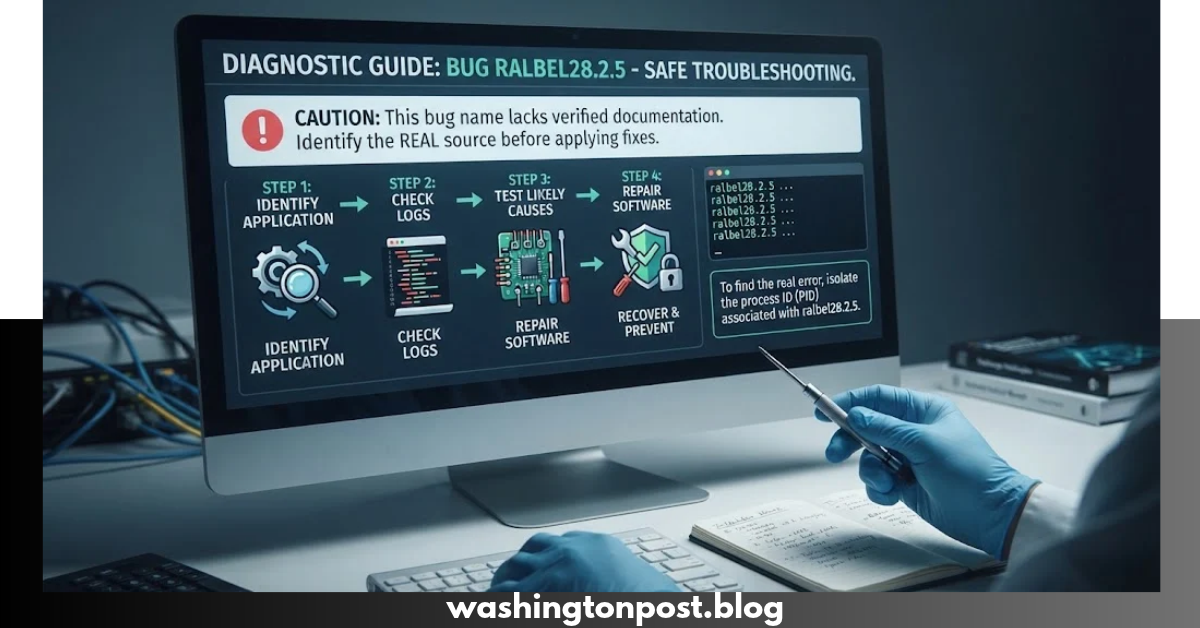
A strange version label can make a software problem feel much harder than it is. If you are searching for fix bug ralbel28.2.5, the first step is not to install a random patch or change system files. The name lacks verified documentation to prove one universal cause. This guide gives you a safe, practical way to identify the application, read the real error, test likely causes, repair the affected software, and recover without risking your files.
What Is Ralbel28.2.5?
Ralbel28.2.5 looks like a product, package, component, or internal build label followed by a three-part version number. However, there is no clearly identifiable first-party product page, release note, or public issue record that establishes exactly what “Ralbel” represents.
That distinction matters. Search results can repeat the same technical claim many times, but repetition does not turn an unverified claim into official documentation.
The safest interpretation is to treat the string as a clue rather than a diagnosis. It may identify an application, dependency, private component, build, plugin, or internal error reference.
Is Ralbel28.2.5 a Confirmed Software Bug?
At present, there is not enough authoritative evidence to call Ralbel28.2.5 a confirmed, universal software bug with one official fix. Different online pages associate the same string with different causes, which makes it unsafe to present one of those explanations as fact.
This does not mean the error you are seeing is imaginary. Your application may genuinely crash, freeze, fail to install, reject a dependency, or display an unexpected version string. The important point is that the actual program and complete error message must be identified before you apply a product-specific solution.
What Problems Can the Ralbel28.2.5 Error Cause?
A version-related error can appear in several forms. Common symptoms include:
- The application closes during startup.
- An update fails or repeatedly asks to install again.
- A plugin or extension stops working.
- The program becomes slow or unresponsive.
- A dependency cannot be found or loaded.
- A page shows a JavaScript error.
- A container or service exits unexpectedly.
- A build works on one machine but fails on another.
- A login or API request stops working after an update.
- Old configuration files conflict with a newer release.
These symptoms are not proof that all affected systems share one Ralbel28.2.5 defect. Use them as diagnostic signals and compare them with the exact log or error message.
What Should You Check Before You Try to Fix Bug Ralbel28.2.5?
Before changing anything, capture the evidence. Write down the application name, installed version, operating system, exact error text, time of failure, and the action that triggered the problem.
Also ask what changed immediately before the failure:
- Was the application updated?
- Was a plugin installed or removed?
- Did the operating system update?
- Did a configuration file change?
- Did a dependency or runtime change?
- Did the problem begin on one device or every device?
- Does an older version still work?
That information turns a vague search into a reproducible technical problem and gives you the evidence needed to fix bug ralbel28.2.5 without guessing.
How Do You Fix Bug Ralbel28.2.5 Safely?
The safest fix starts with the least destructive option. Close the affected application, restart it, and test the same action again. If the issue remains, check for an official update or repair option from the software vendor rather than downloading an unknown “fix” from a random website.
For Windows applications, Microsoft provides built-in Repair and Reset options for supported apps. These options can correct certain application problems without immediately requiring a full reinstall.
If the software is browser-based, open the browser’s developer tools and inspect the Console for the first meaningful error. Browser consoles can show the error type, source file, line number, and call stack, which can narrow the problem considerably.
Identify the Real Source of the Error
To fix bug ralbel28.2.5 correctly, search the complete error, not just the version string. A message such as Ralbel28.2.5 failed to load module X gives you much more information than the isolated phrase Ralbel28.2.5.
Check these locations:
- Application error logs
- Browser Developer Tools
- Windows Event Viewer
- Terminal output
- Container logs
- Build or deployment logs
- Crash reports
- Package-manager output
If the string appears inside a log, copy several lines before and after it. The surrounding lines often reveal the component that actually failed.
Check What Changed Recently
A bug that appears immediately after an update is often easier to investigate because you have a useful comparison point.
Compare the working state with the failing state. Check the application version, plugin versions, runtime version, environment variables, configuration files, and dependency versions.
Do not change several variables at once. If you update five components and the error disappears, you may not know which change solved it.
Repair or Reinstall the Affected Application
If the software itself appears damaged, use its official repair process first. On supported Windows applications, go to Settings > Apps > Installed apps, open the app’s advanced options, and choose Repair when available.
If Repair does not help, a Reset option may be available. Remember that Reset can remove application data or settings, so back up important information first.
A clean reinstall should come later, especially when the problem involves damaged installation files. This order makes it easier to fix bug ralbel28.2.5 while preserving useful diagnostic evidence.
Download the installer only from the official vendor or a trusted package repository.
Check Dependencies and Compatibility
Many software failures are not caused by the main application. A missing runtime, incompatible plugin, outdated library, or incorrect configuration can break an otherwise healthy installation.
Create a simple compatibility checklist:
| Area | What to Check | Warning Sign | Safe Action |
| Application | Installed version | Failure began after update | Compare with previous working version |
| Operating system | OS version and updates | App suddenly stops launching | Check vendor compatibility |
| Runtime | Node, Java, Python, .NET, etc. | Module or runtime error | Match the supported runtime |
| Plugins | Extensions and add-ons | Error disappears when disabled | Update or remove the conflicting plugin |
| Dependencies | Package versions | Missing-module message | Restore compatible versions |
| Configuration | Environment and settings | Works on one machine only | Compare working and failing configs |
| Network | API, DNS, proxy, firewall | Connection or timeout errors | Test the service independently |
| Storage | Disk space and permissions | Write or install failure | Free space and verify access |
The goal is to find the smallest mismatch that explains the failure, which is a key part of any attempt to fix bug ralbel28.2.5.
Inspect Browser Errors and Console Messages
If the problem happens inside a website or web application, open Developer Tools and select the Console tab.
Look for the first red error rather than the final cascade of messages. A JavaScript exception can trigger several later failures, so fixing the first meaningful error often gives you the clearest path forward.
Record the error name, file, line number, request URL, and relevant stack trace. Do not share passwords, API keys, cookies, access tokens, or private customer data when asking for help.
Check Logs in Containers or Services
If the application runs in Docker, inspect the container output before changing the image or deleting data. The docker logs command can show output from a running container, including standard output and error streams.
For service-based systems, also check whether logs are being redirected to another logging backend. A missing message in docker logs does not automatically mean the application produced no error.
Useful checks include:
docker ps
docker logs <container>
docker logs –tail 200 <container>
Replace the placeholder with your real container name or ID.
Roll Back a Recent Change
If the error started immediately after a deployment, update, configuration change, or dependency upgrade, rolling back to the last known-good state can restore service while you investigate.
For source-controlled projects, Git provides git bisect to locate the change that introduced a bug. It works by comparing a known-good revision with a known-bad revision and narrowing the range until the problematic change is identified.
A rollback is not the same as a permanent fix. It can still help you fix bug ralbel28.2.5 by restoring a stable baseline for comparison.
Test One Change at a Time
A clean troubleshooting process needs controlled testing.
Change one item, reproduce the problem, and record the result. If the error remains, return to the previous state before testing the next possibility.
This approach prevents a common mistake: changing the application, runtime, plugins, configuration, and database at the same time. You may get a temporary improvement but lose the evidence needed to find the actual cause.
Protect Your Data Before Resetting Anything
A reset or reinstall can remove local settings, cached data, extensions, or application-specific files. Before using destructive recovery steps, make a backup.
Protect:
- Documents and project files
- Configuration files
- Database exports
- Saved application settings
- API credentials stored in secure managers
- License information
- Custom scripts
- Recovery codes
Never paste private credentials into an online troubleshooting forum or an AI tool while sharing an error log.
When Should You Avoid a Random Fix?
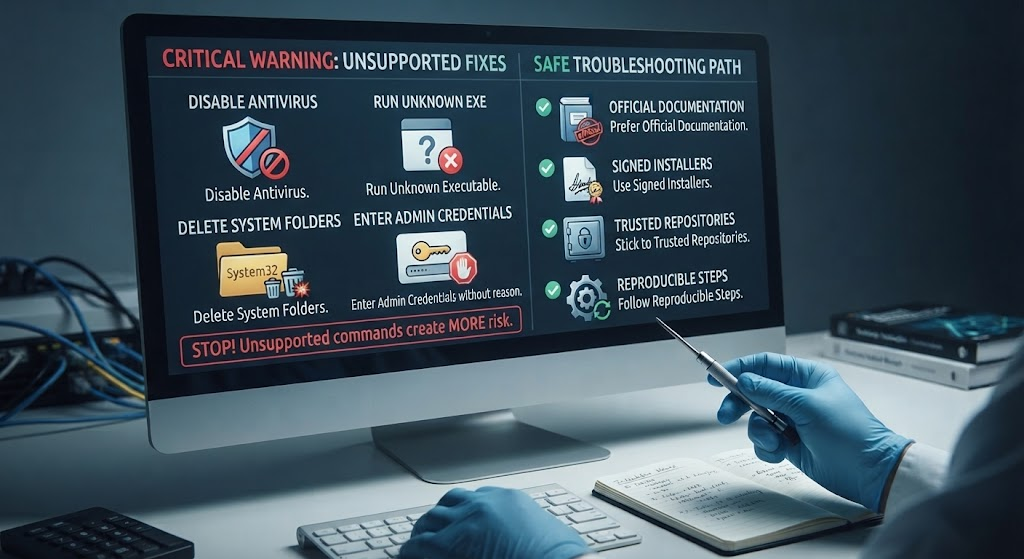
Avoid any “one-click fix” that asks you to disable antivirus protection, run an unknown executable, delete system folders, or enter administrator credentials without a clear reason.
A technical page can look convincing while offering no evidence that its command belongs to your software. When the identity of Ralbel28.2.5 itself is unclear, unsupported commands create more risk than value.
Prefer official documentation, signed installers, trusted repositories, and reproducible troubleshooting steps.
Common Causes and the Best Response
The following table gives a practical decision guide.
| Possible Cause | Typical Sign | First Test | Recommended Response |
| Damaged installation | App will not start | Repair or reinstall | Use official installer |
| Recent update | Problem began after upgrade | Test previous version | Roll back and report regression |
| Dependency mismatch | Missing module or runtime error | Compare versions | Install supported dependency |
| Plugin conflict | App works when plugin is disabled | Disable one plugin | Update or remove it |
| Bad configuration | Same version works elsewhere | Compare settings | Restore known-good config |
| Browser script error | Console shows exception | Inspect first error | Fix source or affected asset |
| Container failure | Container exits | Read container logs | Fix image, config, or process |
| Permission problem | Access denied | Check file ownership | Correct permissions safely |
| Network issue | Timeout or API failure | Test endpoint separately | Check DNS, proxy, firewall |
| Corrupt cache | Old data behaves incorrectly | Clear supported cache | Rebuild cache through normal tools |
Can You Prevent Another Ralbel28.2.5 Problem?
Yes, you can reduce the chance of repeat failures by keeping a record of working versions and changes.
Use version control for application code and configuration. Keep dependency versions documented, test updates in a staging environment when possible, and maintain recent backups.
For production systems, also monitor application errors and keep enough logs to compare a healthy release with a failing release. Good records make future debugging faster because you can identify what changed instead of starting from zero.
How Developers Can Investigate the Bug More Deeply
Developers should create a minimal reproduction case whenever possible. Remove unrelated plugins, data, integrations, and configuration until the smallest setup that still fails remains.
If the problem is inside a Git repository, identify one known-good revision and one known-bad revision. Git’s bisection workflow can then narrow the regression to a specific change instead of requiring manual inspection of every commit.
For web applications, use browser developer tools, console messages, network requests, breakpoints, and stack traces. For containerized applications, preserve logs from the failing run before restarting or replacing the container.
What Information Should You Give Support?
If you need vendor or developer support, provide a compact technical report instead of writing only “it is broken.”
Include:
- Exact application name
- Exact version
- Operating system
- Full error message
- Steps to reproduce
- Expected result
- Actual result
- Time the issue started
- Recent updates or changes
- Relevant log excerpt
- Whether another machine has the same problem
- What troubleshooting steps you already tried
This makes the report easier to reproduce and prevents support from asking for information you could have included in the first message.
Quick Fix Checklist for Ralbel28.2.5
Use this checklist from top to bottom when you need to fix bug ralbel28.2.5:
- Capture the complete error message.
- Identify the application or component producing it.
- Record the exact version and operating system.
- Check what changed immediately before the failure.
- Restart and reproduce the issue.
- Check official updates or repair tools.
- Review application, browser, or service logs.
- Check dependencies and plugins.
- Test one change at a time.
- Roll back the last known-good change if needed.
- Back up important data before reset or reinstall.
- Report the exact evidence to the vendor or developer.
Frequently Asked Questions
What is fix bug ralbel28.2.5?
Short answer: It is a search phrase for troubleshooting a software-related error identified with the string “Ralbel28.2.5.” There is not enough authoritative public documentation to confirm one universal product, cause, or official fix.
How do I fix bug ralbel28.2.5 quickly?
Short answer: Identify the application first, capture the complete error, check recent changes, use the official repair or update process, and review logs before attempting a reinstall. Avoid random patches that are not tied to an identifiable vendor.
Is Ralbel28.2.5 a real software version?
Short answer: The string looks like a software or component version, but its exact identity is not clearly established by an identifiable first-party source. Treat it as an identifier until the application or package that produced it is confirmed.
Can reinstalling solve the Ralbel28.2.5 problem?
Short answer: A reinstall can help when installation files are damaged, but it is not a guaranteed solution. Back up important settings and data first, then use an official installer or trusted package source.
What if the error started after an update?
Short answer: Compare the new release with the last known-good version. If the previous version works, a rollback can restore stability while you investigate the change that introduced the problem.
Conclusion
The smartest way to fix bug ralbel28.2.5 is to diagnose the source before changing the system. The name alone does not provide enough evidence for a single technical explanation, so start with the complete error, application identity, logs, recent changes, and version information.
Use official repair and update tools, test changes in a controlled order, protect your data, and roll back only when you have a known-good state. If you can share the exact error message and the application that displays it, you can turn an unclear version label into a specific technical problem with a much clearer path to a real fix.