FintechZoom.io Nasdaq: Guide to Charts & Market Data
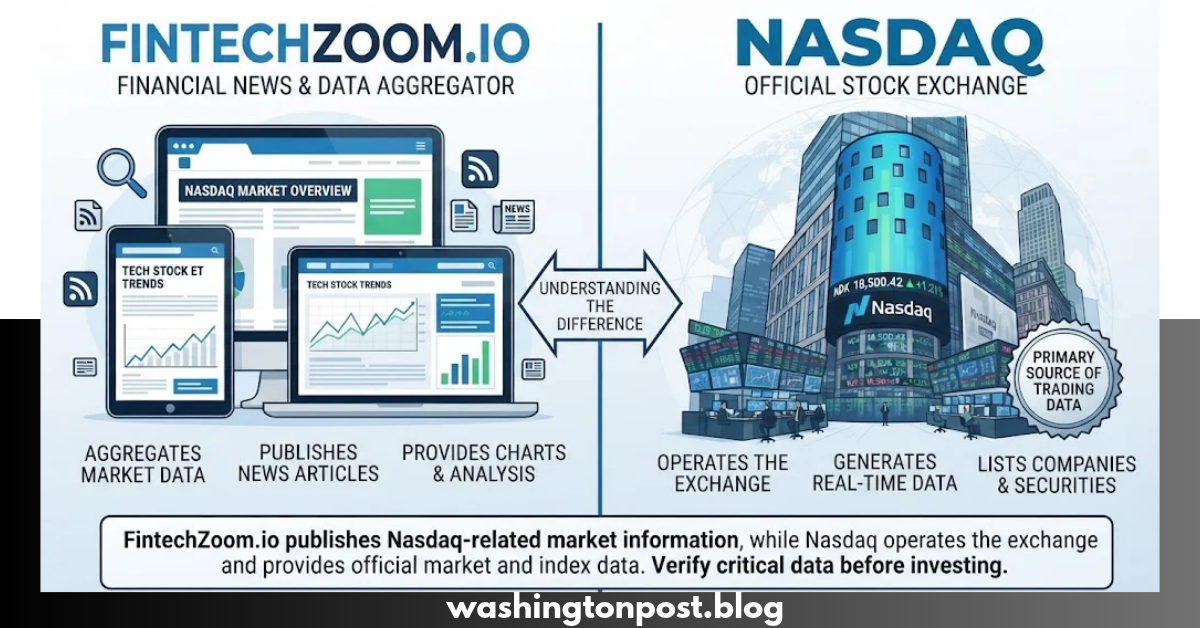
Searching for fintechzoom.io nasdaq can lead to confusion because the phrase combines a website name with a major U.S. stock market brand. Investors may expect to find a Nasdaq ticker, live index, or specific financial product, but the phrase itself is not a Nasdaq-listed security. FintechZoom.io publishes Nasdaq-related market information, while Nasdaq operates the exchange and provides official market and index data. Understanding that difference helps readers use financial websites more effectively and verify important information before making an investment decision.
What Is FintechZoom.io Nasdaq?
FintechZoom.io Nasdaq generally refers to Nasdaq-related market coverage available through FintechZoom.io. The website describes itself as a financial technology and market-information platform covering areas such as Nasdaq, Dow Jones, stocks, crypto, and other financial markets. Its Nasdaq section focuses on market movements, technology companies, earnings information, charts, and related analysis.
The important point is that fintechzoom.io nasdaq is not the name of a stock or an official Nasdaq index. It is better understood as a search phrase connecting FintechZoom.io with its Nasdaq coverage.
That distinction matters because Nasdaq contains many securities and several major indexes. A website discussing Nasdaq does not automatically represent Nasdaq itself, and a website’s market commentary should not be confused with an exchange’s official data.
Is FintechZoom.io Nasdaq a Stock or Ticker Symbol?
No. FintechZoom.io Nasdaq is not a stock ticker symbol.
A stock represents ownership in a company, while a market index measures the performance of a group of securities. Investor.gov explains that stocks represent ownership in a company and that their prices can rise or fall based on many factors.
The Nasdaq Stock Market, meanwhile, is an actual U.S. equities exchange. Nasdaq describes its flagship exchange as a major U.S. equities venue that provides liquidity, price discovery, and market infrastructure.
Quick identification table
| Search term | What it refers to | Is it a stock? |
| fintechzoom.io nasdaq | Search phrase for FintechZoom.io Nasdaq coverage | No |
| Nasdaq Stock Market | U.S. stock exchange | No |
| Nasdaq Composite | Market index | No |
| Nasdaq-100 | Market index | No |
| NDAQ | Nasdaq, Inc. stock ticker | Yes |
| Individual Nasdaq-listed company | A company whose shares trade on Nasdaq | Yes |
This distinction prevents a common research mistake: treating a website, exchange, index, and individual stock as if they were the same thing.
What Is Nasdaq?
Nasdaq is both a major U.S. stock market exchange and a global financial technology company. Its official website provides information about listed securities, market activity, indexes, trading infrastructure, market data, and financial technology products.
The Nasdaq Stock Market provides an electronic marketplace where buyers and sellers can trade listed securities. Nasdaq also operates other market venues and supplies market-data products used by financial institutions and investors.
This creates an important distinction between Nasdaq the exchange, Nasdaq indexes, and Nasdaq, Inc., the publicly traded company.
What Nasdaq Information Can You Find Through FintechZoom.io?
The fintechzoom.io nasdaq search topic can lead readers to several types of market information. FintechZoom.io says its Nasdaq coverage includes market movements, technology stocks, earnings reports, industry analysis, and charts.
Depending on the page and data source, readers may encounter:
- Nasdaq market commentary
- Nasdaq Composite information
- Stock charts
- Company earnings discussions
- Technology-sector coverage
- Historical market information
- Market news
- Technical indicators
- Related financial analysis
- Broader financial-market commentary
These features can help with research, but readers should still verify important numbers against the exchange, company filings, or another authoritative source.
FintechZoom.io Nasdaq vs. Official Nasdaq Data
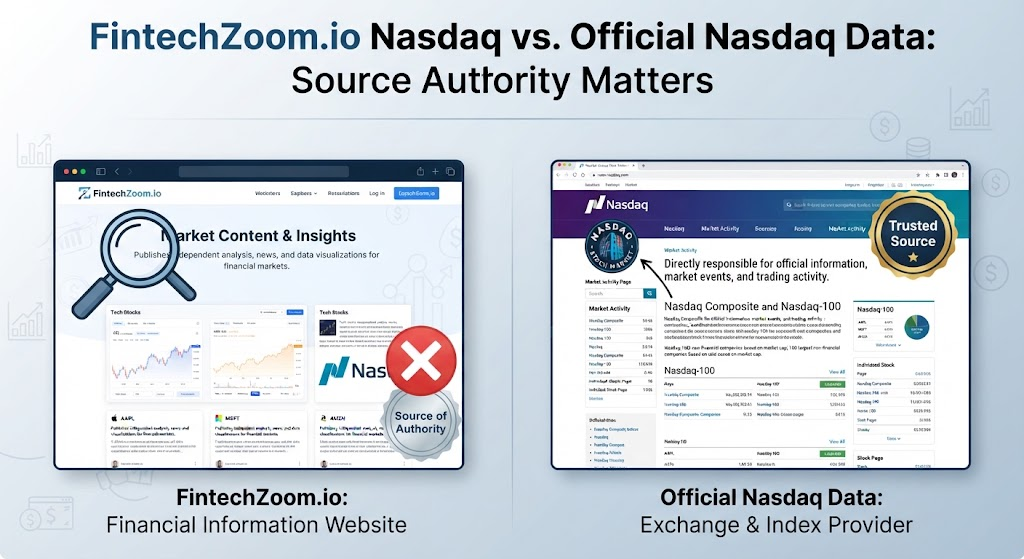
One of the most important differences is source authority.
FintechZoom.io is a financial information website that publishes its own market content. Nasdaq is the exchange and index provider responsible for official information about its markets and indexes. Nasdaq’s market-activity pages provide information about stocks, indexes, market events, and trading activity.
For example, Nasdaq explains that the Nasdaq Composite covers common stocks listed on the Nasdaq Stock Market, while the Nasdaq-100 tracks 100 of the largest non-financial companies listed on Nasdaq based on market capitalization.
Comparison table
| Feature | FintechZoom.io | Nasdaq.com |
| Financial news | Yes | Yes |
| Market commentary | Yes | Yes |
| Nasdaq market information | Yes | Yes |
| Official Nasdaq exchange source | No | Yes |
| Official Nasdaq index information | Secondary coverage | Yes |
| Stock research content | Yes | Yes |
| Exchange infrastructure information | Limited | Yes |
| Regulatory and market-structure resources | Limited | Yes |
The practical approach is simple: use financial publishers for context and discovery, then verify important market facts through primary sources.
What Is the Nasdaq Composite Index?
The Nasdaq Composite is one of the most widely recognized Nasdaq indexes. Nasdaq states that the Composite includes domestic and international common stocks listed on the Nasdaq Stock Market.
This means the Nasdaq Composite is broader than the Nasdaq-100.
The Nasdaq-100, by comparison, contains 100 of the largest domestic and international non-financial securities listed on the Nasdaq Stock Market, based on market capitalization.
Nasdaq Composite vs. Nasdaq-100
| Characteristic | Nasdaq Composite | Nasdaq-100 |
| Type | Market index | Market index |
| Coverage | Nasdaq-listed common stocks | 100 large non-financial Nasdaq-listed securities |
| Number of securities | More than 2,500, according to Nasdaq | 100 |
| Main use | Broad Nasdaq market measurement | Large-company benchmark |
| Financial companies | Included where eligible | Excluded from the index methodology |
| Common association | Broad Nasdaq market | Large growth and innovation-oriented companies |
Understanding this difference is essential when reading any fintechzoom.io nasdaq chart or article.
How to Read a Nasdaq Chart
A chart can show much more than whether an index or stock moved up or down.
When reviewing Nasdaq-related information, examine these elements:
1. Price or index level
Check the current or displayed value. Confirm whether the figure represents the Nasdaq Composite, Nasdaq-100, an individual stock, or an exchange-traded product.
2. Time period
A one-day chart tells a different story from a five-year chart. Always identify whether the chart displays intraday, daily, weekly, monthly, or long-term data.
3. Percentage change
Percentage movement provides useful context because a $10 move means something very different for a $50 security than for a $500 security.
4. Trading volume
Volume can show how actively a security traded during a period. Compare unusual volume with company announcements, earnings releases, market events, or other documented information.
5. Technical indicators
Moving averages, relative strength indicators, and other technical tools can help describe historical price behavior. They should not be treated as guaranteed predictions of future prices.
6. Data timestamp
Always check when the information was updated. Nasdaq notes that most of its indexes are updated in real time during market hours, with public display subject to at least a one-minute delay.
Why Investors Search for FintechZoom.io Nasdaq
The phrase fintechzoom.io nasdaq attracts attention because investors often want one place to find market charts, financial news, and stock information.
FintechZoom.io itself says that it covers Nasdaq movements and provides information about technology stocks, company earnings, and market analysis.
Readers may search the phrase to:
- Find Nasdaq market updates
- Explore technology stocks
- Review historical charts
- Understand index movements
- Read financial commentary
- Research companies before deeper due diligence
- Compare market trends
- Find related financial resources
The best use of this type of content is as a research starting point, not as a replacement for primary financial records.
How to Verify FintechZoom.io Nasdaq Information
Financial information can change quickly. A strong research process checks important claims against authoritative sources.
Step 1: Identify the exact security
Find the company name and ticker symbol. Do not assume that a website name or article title represents a tradable asset.
Step 2: Check Nasdaq
Use Nasdaq’s official market-activity pages to verify listed securities, market information, index details, and trading-related information.
Step 3: Check company filings
For public companies, Investor.gov explains that company information can be found through the SEC’s EDGAR system, including required public-company reports.
Step 4: Read the original announcement
If an article discusses earnings, an acquisition, a product launch, management changes, or another major event, locate the company’s original announcement or regulatory filing.
Step 5: Check the date
Market information becomes outdated quickly. A chart or article from an earlier period should not be presented as current market data.
How to Research Nasdaq Stocks More Effectively
A useful stock-research process should combine price information with business fundamentals.
Start with the company’s identity and business model. Then review revenue, earnings, cash flow, debt, competitive position, major risks, and recent company filings.
Investor.gov notes that stock prices can be affected by company-specific factors such as management, products, consumer demand, economic conditions, labor costs, supply chains, and investor preferences.
A practical research checklist
Before relying on information found through fintechzoom.io nasdaq, ask:
- What company or index does this information describe?
- What is the ticker symbol?
- What date does the information represent?
- Is the price delayed or real-time?
- What is the original source?
- Does the company’s latest filing support the claim?
- Are the financial numbers current?
- Does the article distinguish facts from commentary?
- What risks could affect the investment?
- Is the information describing historical performance rather than future results?
This simple process can make online financial research much clearer.
What Makes Nasdaq Important for Technology Stocks?
Nasdaq has a strong association with technology and growth-oriented companies, although the exchange is not limited to technology businesses.
Nasdaq’s official materials show that its markets contain thousands of corporate listings and that its indexes cover broad market, sector, thematic, and strategic categories.
This broad ecosystem explains why Nasdaq frequently appears in financial technology coverage.
However, a company being listed on Nasdaq does not automatically make it a technology company or guarantee strong performance. Investors should evaluate each security based on its own financial position, business model, valuation, risks, and objectives.
FintechZoom.io Nasdaq and Real-Time Market Data
One area that requires special attention is the phrase “real-time.”
A financial website may display a live-looking chart while the underlying data has a delay or comes from an external market-data provider. Nasdaq itself explains that most indexes are updated in real time during market hours, while public display can have at least a one-minute delay.
Therefore, readers should look for:
- Data source
- Timestamp
- Market status
- Exchange information
- Delay disclosure
- Index or ticker symbol
- Currency
- Trading session
These details help prevent incorrect comparisons.
Is FintechZoom.io Nasdaq Useful for Beginners?
Yes, it can be useful as an introductory research resource, particularly when a reader wants to understand market terminology, discover companies, or explore Nasdaq-related topics.
However, beginners should not rely on a single website to make an investment decision. Investor.gov emphasizes understanding investment risk, fees, diversification, liquidity, and the characteristics of the investment before committing money.
A beginner-friendly research workflow looks like this:
Discover → Verify → Compare → Understand Risk → Decide
The first step may involve FintechZoom.io or another financial publisher. Verification should move toward primary sources such as Nasdaq, SEC filings, and company investor-relations materials.
Risks of Relying on Online Stock Commentary
Financial articles can simplify complicated market events. That can make information easier to understand, but it can also remove important context.
A rising stock price does not prove that a company is financially strong. Likewise, a falling price does not by itself explain whether the business has changed.
Investor.gov states that all investments involve risk and that investors can lose money. It also highlights asset allocation and diversification as important parts of managing investment risk.
Common research mistakes
- Treating an index as a stock
- Confusing a website with an exchange
- Assuming historical returns will repeat
- Ignoring the publication date
- Relying on one article
- Skipping company filings
- Ignoring fees
- Overlooking concentration risk
- Treating technical indicators as guarantees
- Confusing commentary with official market data
Avoiding these mistakes creates a much stronger foundation for financial research.
How Diversification Fits Into Nasdaq Investing
Nasdaq exposure can involve individual stocks, index products, exchange-traded funds, or other securities. The appropriate choice depends on an investor’s goals, time horizon, and risk tolerance.
Investor.gov explains that diversification involves spreading investments across different assets and securities to reduce concentration risk.
FINRA similarly explains that diversification can reduce the risk associated with overemphasizing a single security or asset class.
That means researching one popular Nasdaq company is not the same as building a diversified portfolio.
FintechZoom.io Nasdaq Research Checklist
Use this table when evaluating an article, chart, or market claim.
| Research factor | What to check | Why it matters |
| Asset | Stock, index, ETF, or other security | Prevents category errors |
| Ticker | Exact symbol | Identifies the security |
| Date | Publication and data date | Market information changes |
| Data source | Nasdaq, SEC, company, or third party | Establishes authority |
| Price | Current or historical | Provides time context |
| Volume | Trading activity | Adds market context |
| Fundamentals | Revenue, earnings, debt, cash flow | Shows business condition |
| Valuation | Relevant valuation measures | Adds pricing context |
| Risk | Business and market risks | Supports balanced research |
| Diversification | Other portfolio holdings | Helps manage concentration |
| Filing | SEC/company documentation | Supports verification |
| Commentary | Opinion versus fact | Prevents overinterpretation |
This checklist can turn a quick Google search into a more disciplined research process.
FintechZoom.io Nasdaq vs. FintechZoom.com
Readers should also pay attention to the domain they visit.
FintechZoom.io currently presents itself as a financial information website and has a dedicated Nasdaq section.
FintechZoom.com also publishes Nasdaq-related content. Its Nasdaq page identifies the Nasdaq Composite with the index symbol .IXIC and provides chart, performance, technical, and news information.
Because the domains are different, readers should check the address bar carefully before assuming that two websites are operated as the same service.
For important financial decisions, domain recognition should never replace source verification.
How to Use FintechZoom.io Nasdaq Without Overrelying on It
A balanced workflow can make fintechzoom.io nasdaq more useful.
Use FintechZoom.io for discovery
You can use market articles and charts to identify topics that deserve further research.
Use Nasdaq for exchange information
Nasdaq provides official information about its markets, indexes, listings, market activity, and market structure.
Use SEC filings for company facts
Investor.gov directs investors toward SEC EDGAR for information about public companies and their filings.
Use company investor-relations pages
For earnings, guidance, acquisitions, product announcements, and management information, the company’s own investor-relations materials provide an important primary source.
Use multiple sources before acting
If several sources repeat the same claim, trace the information back to the original document whenever possible.
Frequently Asked Questions
What is FintechZoom.io Nasdaq?
Answer: FintechZoom.io Nasdaq refers to Nasdaq-related market coverage available through FintechZoom.io. It is not a stock, ticker symbol, or Nasdaq index. FintechZoom.io describes its Nasdaq coverage as including market movements, technology stocks, earnings, charts, and financial analysis.
Is FintechZoom.io an official Nasdaq website?
Answer: No. FintechZoom.io and Nasdaq.com are separate websites. Nasdaq.com is the official website for Nasdaq’s markets, indexes, market data, and corporate information.
What is the Nasdaq Composite?
Answer: The Nasdaq Composite is an index covering common stocks listed on the Nasdaq Stock Market. Nasdaq states that it covers more than 2,500 stocks.
What is the Nasdaq-100?
Answer: The Nasdaq-100 is an index of 100 of the largest domestic and international non-financial securities listed on the Nasdaq Stock Market, based on market capitalization.
Can I use FintechZoom.io Nasdaq for investment research?
Answer: Yes, it can serve as a research and discovery resource. For important financial facts, verify information through primary sources such as Nasdaq, SEC filings, and company investor-relations documents.
Is Nasdaq investing risk-free?
Answer: No. Stocks and other market investments can lose value. Investor.gov states that all investments involve risk and recommends considering factors such as risk tolerance, time horizon, diversification, fees, and liquidity.
Conclusion
Fintechzoom.io nasdaq is best understood as a search phrase for Nasdaq-related financial coverage on FintechZoom.io, not as a standalone stock or Nasdaq ticker. FintechZoom.io can help readers discover market topics, charts, company news, and Nasdaq-related analysis, while Nasdaq remains the primary source for official exchange and index information.
The strongest research process combines convenience with verification: discover information through financial media, confirm market details through Nasdaq, examine company filings through SEC resources, and review the risks before making an investment decision. Investor.gov also emphasizes diversification, appropriate asset allocation, and understanding the risks associated with investments.